
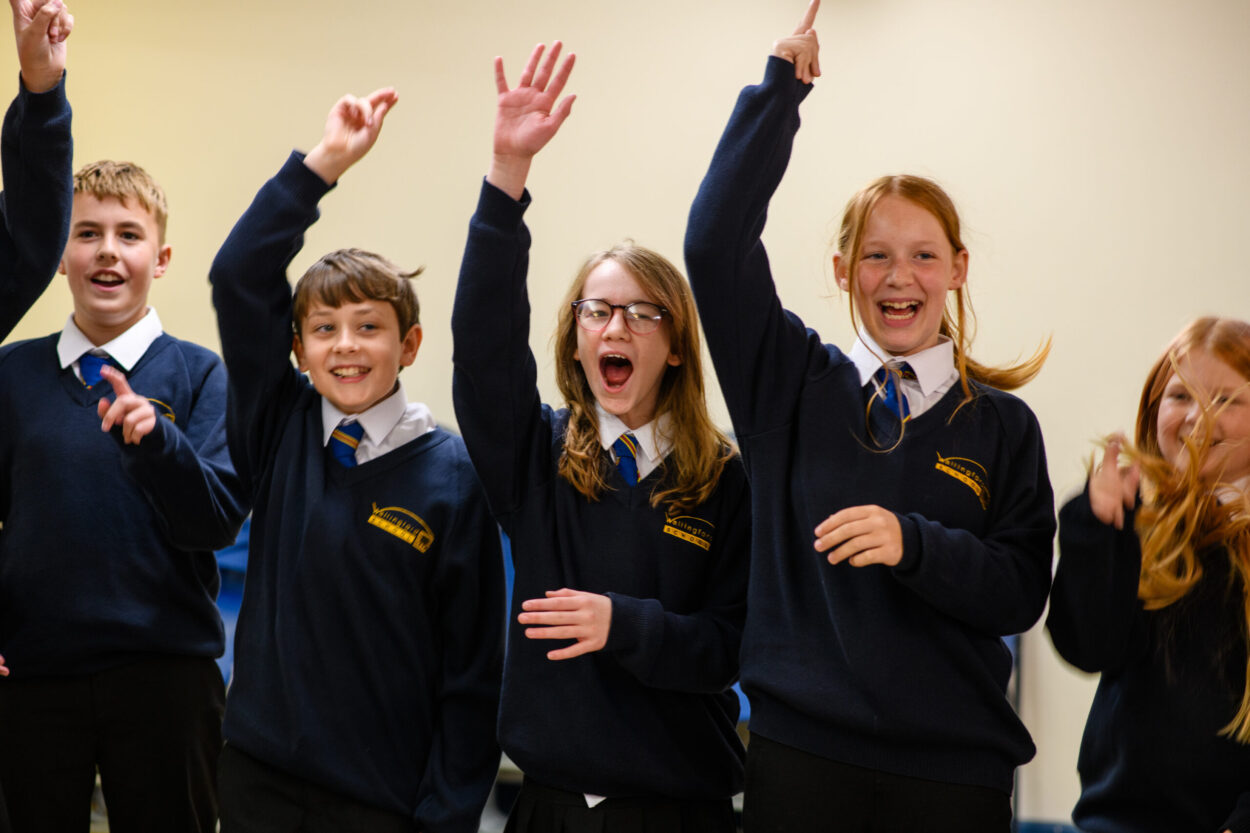
Anthony Cockerill meets Tom Davey, the man behind Bright Torches, the organisation providing workshops, teacher training programmes and projects designed to complement the curriculum and strengthen speaking and listening skills.
Shakespeare can be one of the most challenging aspects of the curriculum for new teachers to grapple with. No matter how well we might know his work, the task of making Britain’s most famous dramatist understandable — navigating his plots, language, stagecraft and characters can feel gargantuan when we’re new to the classroom. The payoffs, of course, are great: wordcraft that has shaped the English language, legendary stagecraft and some of the most memorable characters in English literature.
There are, of course, more compelling reasons for teaching students Shakespeare than simply to acknowledge his literary stature. Shakespeare is not the preserve of the literary critic. His plays are meant to be, performed, seen, heard and embodied.
This notion often gets lost, however. I once saw a teacher post on Facebook: ‘I’m about to start teaching Romeo and Juliet to Year Nine. I don’t know how to start.’
‘By watching it,’ I was tempted to suggest. ‘Put it on. Let it breathe. Allow them to respond.’
But all too often, this notion of Shakespeare as performance is all too often missing from classrooms. It arrives flat-packed and students get to read the instructions rather than rolling their sleeves up.
It’s understandable, of course, that English teachers often lack confidence when it comes to teaching drama texts through the method best invariably suited to it — the interpretive craft of theatre. And thanks to much of the transmissive pedagogy that’s taken root over the past decade — knowledge organisers, annotations, retrieval practice — it feels like there’s even less room for active approaches to Shakespeare.
In education, there is rarely a magic bullet, but if there was in this case, it could well be fired from the pistol of Tom Davey. Tom trained as an actor at RADA and spent two decades performing on stage and screen, playing leading roles at the Royal Shakespeare Company. Over the last 14 years, alongside his acting, he has worked as an education practitioner, supporting theatre education programmes at the RSC, The Young Vic, Good Chance Theatre, London Shakespeare Workout Prison Project and, most notably, Shakespeare’s Globe where he spent many years as a learning consultant.
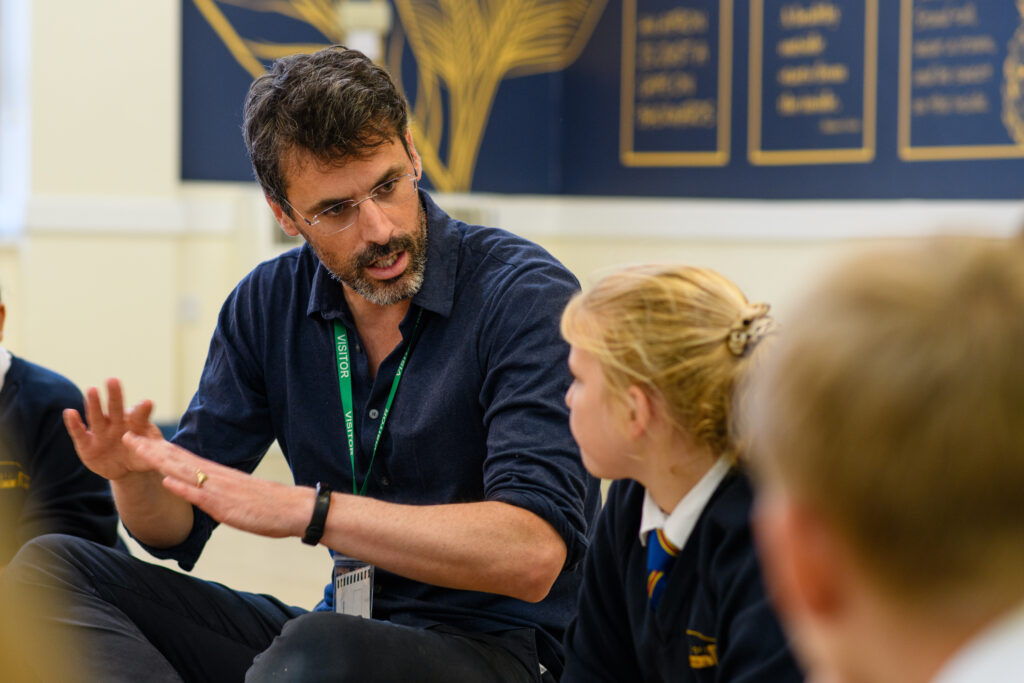
During the long days of lockdown when theatres were dark because of the pandemic, Tom began to ask himself some profound questions. How do we give young people the tools to have empathy with characters? How do we encourage them to see how texts might have been understood in different points in history?
‘I had a notion born out of the joyful experiences I’d had in rehearsal rooms,’ says Tom. ‘I love being an actor. I love being given a licence to explore language and text,’ says Tom. ‘I’d had wonderful experiences working at the RSC and Shakespeare’s Globe.’
As classroom lights began to be turned back on and students returned to school, Tom reached out to schools and PGCSE courses.
‘In those days,’ he says, ‘people were emerging into classrooms with wobbly knees. It started as a conversation about Shakespeare. How can we create community and classrooms full of engagement? How can we encourage children to disagree agreeably? To think critically and to consider perspective?’
Bright Torches, the organisation Tom subsequently founded, declares its mission with refreshing directness: to help people of all ages ‘burn bright’ by encountering literature not as a static body of knowledge, but as something to be done. Tom’s premise is disarmingly simple — that stories are one of the ways we come to understand ourselves — and their method follows naturally: collaboration, conversation, and the shared business of making meaning.
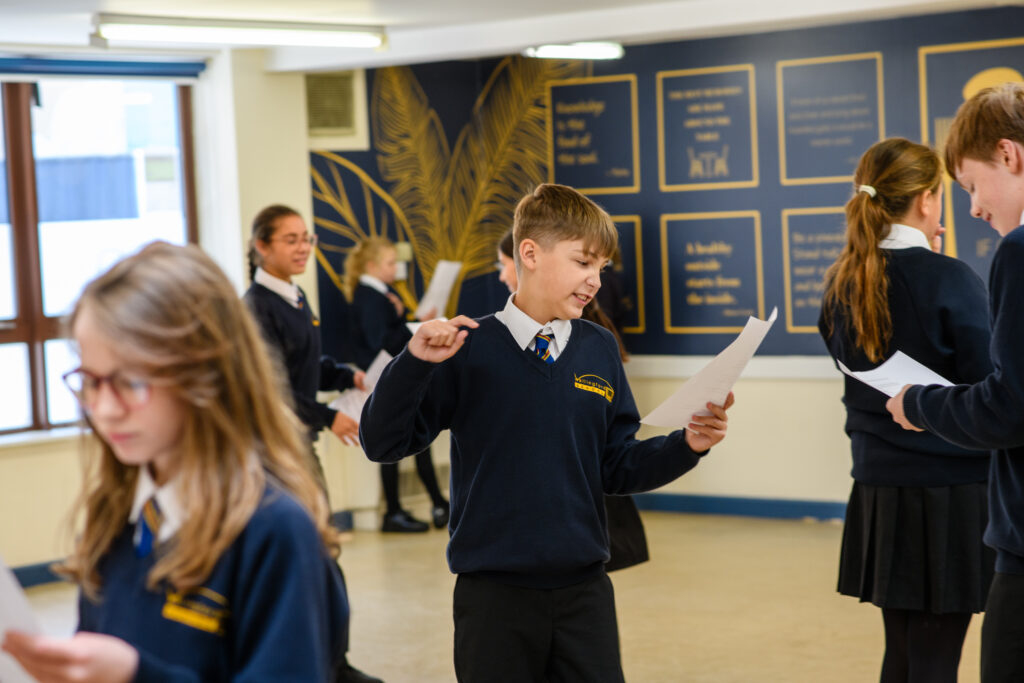
I first met Tom on a visit to George Stephenson High School in Cramlington, a new town on the northern edge of Newcastle. Over the course of the visit, I observed Tom lead three sessions: on The Tempest with Year Seven, Romeo and Juliet with Year Eight, and Macbeth with Year Nine.
Together, these lessons offered a compelling insight into Tom’s approach to teaching drama and Shakespeare — an approach grounded in movement, dialogue, modelling, and high-level intellectual challenge, while remaining inclusive and accessible to all. Crucially, students were talking throughout, and this talk took different forms: team building, performative, explanative, reflective, evaluative, analytical, descriptive.
From the outset of the Year Seven session, students were actively engaged, working on scenes involving Prospero and Caliban. Rather than overwhelm students with masses of text, Tom had chosen some key short passages so students could get their heads around character and relationships. I noticed that crucially, he didn’t treat the text as something static or intimidating. Instead, students were encouraged to workshop dialogue, pausing regularly to reflect, refine, and try alternative interpretations.
He demonstrated three different ways of delivering the line ‘Come thou tortoise’, making visible the range of choices available to performers. By asking ‘Why do you need lots of movement in a Shakespeare play?’, Tom encouraged the students to think beyond the words on the page and consider audience, staging, and physical storytelling. Contextual information — such as the Shakespearean tradition of audiences standing around the stage rather than all being seated — was introduced precisely when it illuminated meaning, rather than as detached background knowledge.
Tom’s use of physical cues — such as ringing a bell to refocus attention and bring the students back together in a circle kept pace and momentum without the need for him to raise his voice. He frequently paused to elucidate moments of dialogue, drawing attention to the difference between soft and hard rhetorical approaches and encouraging students to experiment with dramatic pauses. This explicit focus on how meaning is shaped through delivery supported students in developing both interpretative and performance skills.
The benefit of this approach was clear: students worked confidently with challenging language because they were physically and intellectually involved in making sense of it. They were not passive recipients of interpretation but active constructors of meaning. Tom’s calm but purposeful movement around the room ensured that all students were supported, and his feedback was rapid, specific, and immediately acted upon.
With Year Eight, Tom began by gathering students in a circle, reinforcing the importance of physical readiness, focus, and community. Warm-up activities were used not only to energise students but also as a strategic tool for refocusing attention throughout the session.
Students explored short, potent lines such as ‘Get thee to church’, examining how tone, movement, and emphasis change meaning. Tom repeatedly asked students to describe how they perceived character at different moments in the play, linking interpretation directly to physical choices such as stepping forwards or backwards. This use of embodied learning supported students in grasping abstract concepts such as power, obedience, and conflict.
During show back and in the conversations that were part of it, Tom modelled ambitious vocabulary and explicitly unpacked it. For example, a single word like ‘ripe’ became the focus of sustained exploration, demonstrating how Shakespeare’s language carries emotional and thematic weight. Students were encouraged to explain and justify their choices, reinforcing the idea that interpretation is thoughtful, reasoned, and collaborative.
A notable strength of this session was Tom’s handling of discussion. When a student remarked that ‘patriarchy overruled everything,’ Tom allowed this insight to shape the direction of the session, validating student thinking and using it as a bridge to deeper textual analysis. He asked students to physically position themselves along a continuum to express agreement or disagreement, ensuring that every student had a voice, even before speaking.
Students were rapidly developing confidence in articulating ideas, engaging in respectful debate, and recognising that literature invites multiple interpretations. Tom’s positive reinforcement — ‘That’s a really nice provoking thought’ — encouraged risk-taking and intellectual curiosity.
In the staffroom at lunchtime, Tom and I were able to spend some time discussing Tom’s hopes for Bright Torches — and its mission is to inspire and encourage individuals of all ages to ‘burn bright’ and engage with the world of literature through drama-based activities.
‘Stories,’ Tom explained, ‘have the power to help us understand ourselves. At Bright Torches, we believe that collaboration is crucial in developing social skills and building a brighter future. We work with three-year-olds right up to A-level.’
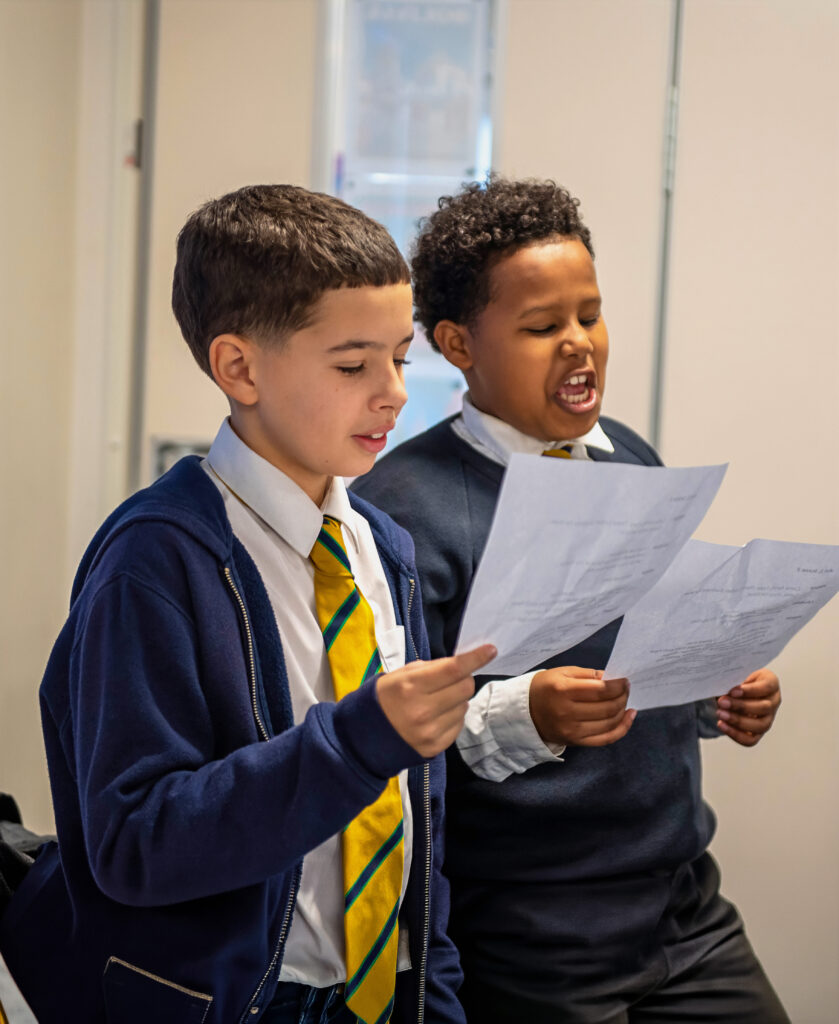
Bright Torches’ range of workshops and projects are designed to complement the curriculum and strengthen speaking and listening skills. They work with schools to support the teaching of Shakespeare, 19th Century novels, poetry and other set texts, and to promote spoken literacy. Their strategies for all learners, delivered through lively, playful activities, accelerate learning, and strengthen connections within the community. One example of this is the Merry Wanderers Transition Project, which begins in the summer of Year Six and which continues into the new term when students reach secondary school, culminating in a performance of A Midsummer Night’s Dream in October.
At secondary level too, Tom makes sure the workshops are designed to provoke authentic personal responses from students during any point in their Shakespeare journey. He has also worked with students in the USA, leading sessions in challenging schools in California where students’ prior experiences of Shakespeare are often a world away from the energy and joy of the rehearsal room.
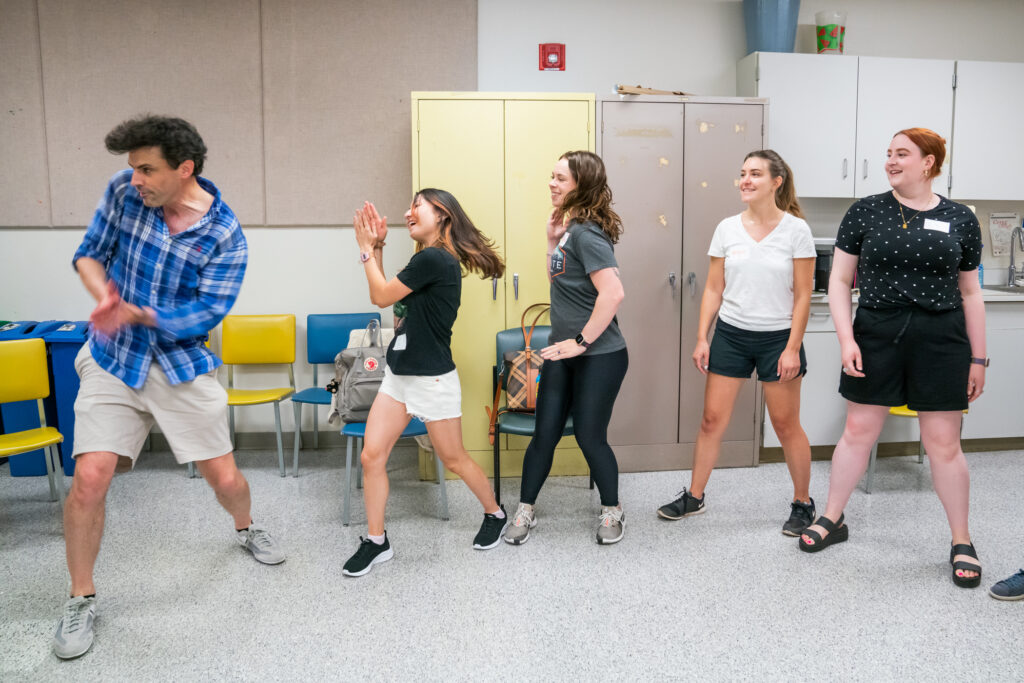
‘One of the hurdles is tackling reticence to talk from students who are not used to it,’ explained Tom. ‘This is why the gateway activities are so important. Teachers can incrementally build their students’ confidence to speak text, play with it and make a personal response so young people feel less inhibited.’
After lunch, we made our way back to the drama studio. The afternoon session with Year Nine focused on – and was characterised by a calm, focused intensity. Tom opened with a strong narrative hook: ‘We’re going to work and think like actors.’ Again, the circle was central, both physically and pedagogically, reinforcing equality, focus, and shared purpose.
Using some carefully selected extracts from Macbeth, students explored themes of power, manipulation, and masculinity through movement, gesture, and vocal delivery.
‘Working on dialogue,’ says Tom, ‘it’s often helpful to think about whispered language rather than proclaimed language.’
Tom balanced stepping back to observe with targeted intervention, asking probing questions such as what certain lines implied and which tactics — force, softening, or probing — were being employed. When students identified moments of emasculation or psychological pressure, Tom pushed them to articulate why, deepening their analytical thinking.
Importantly, Tom normalised uncertainty. When faced with complex lines or ideas, he acknowledged that we do not always understand everything immediately, framing confusion as a starting point for exploration rather than a failure. This approach created a safe intellectual space in which students felt able to take risks and explore difficult ideas.
The benefit for students was clear: they were engaging with Shakespeare at a sophisticated level, grappling with character motivation, subtext, and power dynamics in ways that are often reserved for older learners. Their interpretations were grounded in textual evidence but enriched through physical and emotional understanding.
Tom’s work demonstrated a deep awareness of form, language, themes, and ideas, combined with exceptional classroom presence and relational skill. His methods consistently bridged drama and English, ensuring that performance supported — rather than replaced — textual understanding.
I left the school as the students’ day ended. Tom, however, was staying on to run another session — this time with members of the English department. It’s easy to ‘book a workshop’ for students when it’s delivered by someone as skilful as Tom. But for many English teachers — working with their students day in, day out — there’s often a barrier to using the same sort of rehearsal room techniques that Tom does. This is partly about experience, of course — most English teachers haven’t served the same kind of acting apprenticeship — but Tom is passionate about making these approaches something that all teachers of English can use and draw on, hence his work with teachers and trainees. To this end, Bright Torches has become a charitable incorporated organisation this year, and Tom and his colleagues celebrated the launch event for this new development this September. A funding bid for six schools nationally to participate in the Merry Wanderers Transition Project is in the pipeline.
‘The reason for becoming a charity was so we can expand the work,’ says Tom. ‘There’s so much scope for other people to become involved and place our methods alongside their own expertise and professionalism.’
These are pedagogies that might unsettle, make demands, push people out of their comfort zones. Tom spends much of his time working with ITE trainees, both as part of school-centred initial teacher education but also in partnership with universities around the country. Tom’s approach shows how Shakespeare can be taught not as something to be decoded passively, but as something to be experienced, questioned, embodied and debated. For students, used to being asked to keep quiet for much of the time, Tom tackles reticence to talk.
The result is students who are given room to be confident, articulate, physically engaged, and intellectually challenged — and who clearly enjoy the process of learning.
Find out more about Bright Torches at www.brighttorches.com.
