

Oliver Rowse explains how Dead Poets Live is bringing poetry to life on stage and in classrooms, using performance and participation to inspire a new generation of students
Dead Poets Live was founded by the T. S. Eliot Foundation in 2017 with a simple ambition: to put poetry on stage – and in doing so, to turn theatre-goers into poetry-lovers. Our events have featured performances by acclaimed actors such as Tom Hiddleston, Juliet Stevenson, Anthony Boyle and Sheila Atim. You can find details of our past and future shows at deadpoets.live.
Since March 2023, we’ve taken that mission into schools – and have learned a lot along the way. From Autumn 2025, we’ll be making a wide range of teaching resources freely available online. But to get there – and to keep going – we’re reaching out to teachers. We need your insight, your support, and your voices in shaping what comes next.
Dead Poets Live in secondary schools
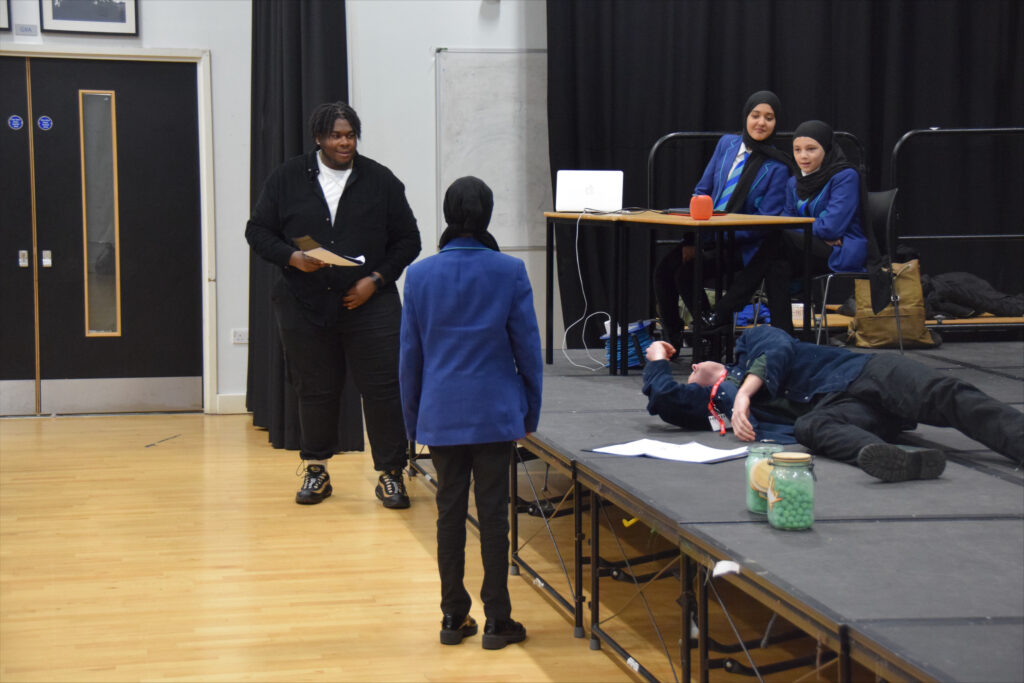
Since October 2022 the focus of Dead Poets Live has expanded to schools, aiming to broaden both the reach and relevance of what we do. We have written several lesson-length shows – the most popular titled ‘What is Poetry?’ – devised specifically for those in Years 7 and 8. These are supposed to serve as an introduction to poetry, so that students have a sense, at the outset, of why, historically, globally, poetry has been important.
‘What is Poetry?’ – to give a sense of one of our shows – is an attempt to answer that question. In the space of 45–50 minutes, we hear poems addressed to Eshu, the Yoruba god of fate, fragments from the Book of Job, songlines of the Aboriginal peoples of Australia, love poetry from Vietnam, Madagascar and Romeo and Juliet and a rap battle (‘flyting’) from sixteenth-century Scotland. The form is something like that of a revue show: a dozen or so skits, each based around a particular poem, performed by a couple of actors, with regular contributions from the audience, who are called on to recite and create poetry.
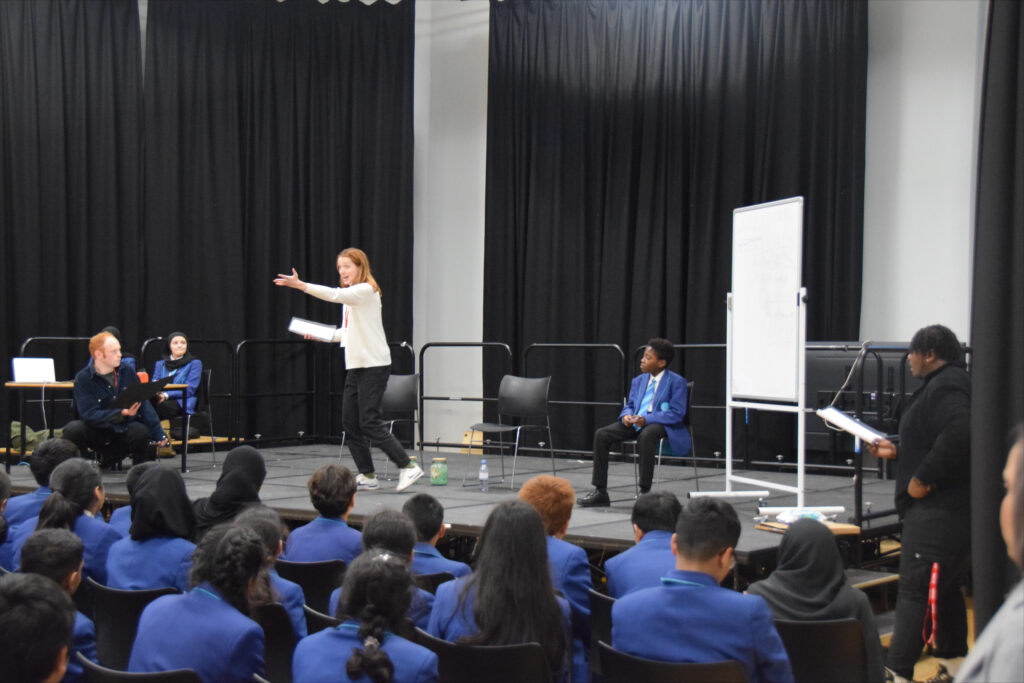
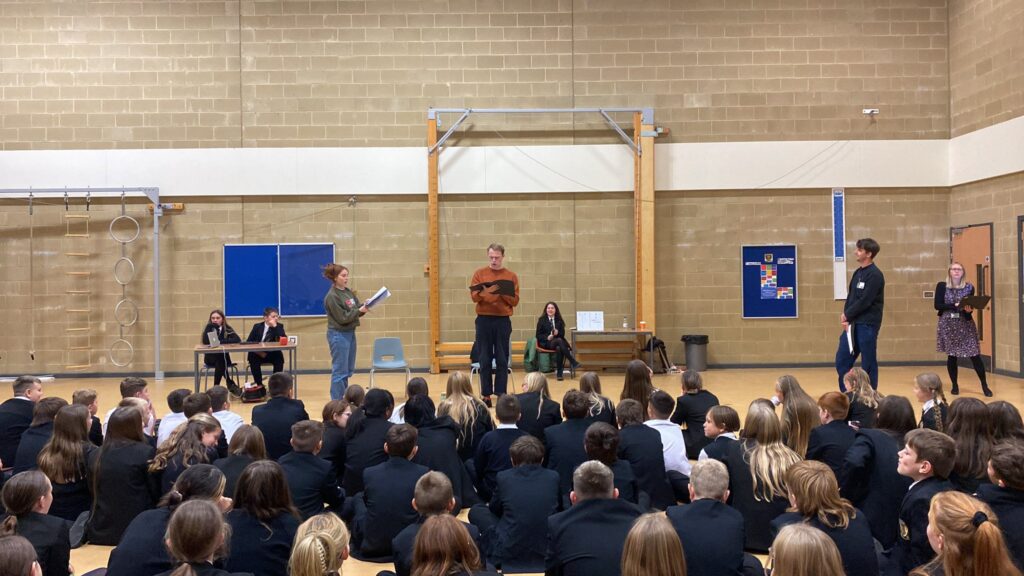
We have mounted numerous regional tours – from the North-East of England to the South-West, from East Anglia to South Wales – always with the intention to cast young drama graduates who are from the regions we tour.
Our shows are supposed to be thought-provoking, but knockabout, with a continuous element of audience participation, and crucially, from the point of view of the schools we visit, entirely free. This was one of our original commitments, and it’s a commitment we continue to keep.
We have learnt so much from our school visits, lessons that will be familiar to anyone who’s taught in a classroom: not to assume knowledge, not to lose the room by doing anything too exciting in the first ten minutes, how to control excitement generally, and how to consolidate the events of the performance into a memorable conclusion, or ‘plenary’. But beyond anything, these performances have taught us about the art of teaching: the sheer number of Key Stage 3 students we have performed to has taught us much about our audience. With Year 7, we can always rely on willing participants, students more than happy to stick their hands at the risk of seeming foolish. With Year 8, that willingness is not always to be depended on, particularly among the young men. This has led us to reflect on the whole question of participation, and how it connects to the pursuit of oracy on the one hand and how we manage anxieties associated with public speaking on the other. Our performances, like all lessons, work best when the students are most involved. But creating the framework in which everyone feels confident to express themselves is a challenge – a challenge that we can’t afford to ignore.
Going digital, remaining ‘live’
As demand has accelerated, the problem of scale has become more urgent. We began with the intention of a truly national project, but with over four thousand secondary schools, the logistics of a national offer are overwhelming. Which is why, since 2024, we have been developing teaching materials, guided by what teachers tell us they need, but true to the participatory spirit of our live shows. These will be available on various platforms, and in a variety of forms, but most comprehensively on the dedicated ‘schools’ section of deadpoets.live, which will launch in time for the beginning of the ’25–’26 school year. It will be freely available, and free to use.
Within the ‘schools’ section of deadpoets.live, teachers will be able to pick and choose from what they find, downloading whatever fits with the way they teach, or whatever they think will interest their students. Initially, there will be three strands of material. We chose these three strands because they addressed the needs of those teachers with whom we’ve built a close relationship. In our range of teaching materials, we aim to serve those who find themselves curriculum-bound and those teaching with comparatively more freedom at Key Stage 3. The first strand addresses poems from the GCSE anthologies. The second addresses aspects of Shakespeare’s language, drawing on the techniques actors use to help break down speeches from his most-studied plays. The third strand uses particular poems to address some of the fundamental formal aspects of poetry – the differences between poetry prose, structure, and rhyme – by way of ‘slow writing’. The hope is that in allowing students to tackle for themselves the decisions that poets must make, they will come to understand a poem as set of choices, the product of intention, which is something that teachers consistently tell us their students struggle with in their responses to poetry.
One of the prototype lessons is from this third category. It deals with the question of line endings – ‘Why does a line end in poetry?’ After sharing their initial thoughts, students are shown William Carlos Williams’s ‘The Red Wheelbarrow’ – but laid out as prose. Their challenge is to introduce line breaks wherever they think they ought to be, to perform their versions, and then to explain their choices. But before they do this, they are shown a couple of short, animated examples taken from Stevie Smith (‘Emily Writes Such a Good Letter’, performed by Juliet Stevenson) and Gwendolyn Brooks (‘We Real Cool’, as delivered by Brooks). And then, immediately before performing their versions, they are shown Toby Jones’s recorded response to the same challenge.

The idea of asking a famous actor or musician to do what the students are about to do, as well as being exciting or funny, is supposed to disinhibit those in the classroom who might be reluctant to share. And on the basis of one airing, at the Sir Robert Woodard Academy in Lancing, this would seem to be the case: ten Year 9 students queued round the class to deliver and then defend their version of ‘The Red Wheelbarrow’.
The same goes for our Shakespeare teaching resources, which were filmed in classrooms, as workshops, with actors explaining how they approach Shakespeare in front of classes of English and drama students. For instance, they explore how they approach Shakespeare’s imagery in order to make it more familiar, but also consider clues as to what their character might be thinking or feeling. They might explain how they approached the question of rhythm or wordplay. The students in the workshop were then invited to have a go for themselves. Their responses have been cut into montages that – once they are set in the context of a lesson – will hopefully disinhibit those who eventually watch them.
With teachers, for teachers
If you would be interested in either a visit from Dead Poets Live, or in hearing more about the ‘schools’ section of deadpoets.live, please feel free to write to me at oliver.rowse@deadpoetslive.org, so that I can arrange a visit or let you know when to expect our launch.
Everything we do is centred on teachers: meeting the needs of teachers in a way that works in their classroom. So far, it is teachers who have shaped our choices about what to produce and how to produce it. And it is teachers, I hope, who will continue to tell us what will work, what they need, and in what form.