

Prompted by the cultural impact of Adolescence, Harmeet Matharu invited Year Eight students to explore masculinity through literature, history and debate — creating space for thoughtful, non-judgemental discussion.
March 2025 saw the premier of the groundbreaking Netflix series Adolescence. Although I had no intention of watching it, my 17-year-old daughter urged me to.
‘The cinematography is amazing,’ she said.
Once I started watching, I was hooked. The one-take episodes were impressive, but it wasn’t just that which captured my attention. The outstanding performance of Owen Cooper highlighted aspects of teenage life that I was previously oblivious to. The success of the show meant that words such as ‘looksmaxing’, ‘manosphere’ and ‘red pill’ had suddenly thrust themselves into the mainstream lexicon. As teachers, we had all heard of Andrew Tate, but this new series made us all aware of how massive the problem of misogyny had become for teenagers.
Preparation
As the Head of English in a boys’ school, I felt that it was important that my department tackled this issue head-on. Adolescence prompted me to create a unit of work that all students would study in Year 8. The theme of the unit was ‘Masculinity’. I wanted the unit to be informative and engaging but I did not want to ‘preach’. I decided that Year Eight was the ideal time for students to tackle the issues that they may already have encountered through social media and through their communities as I felt this was the year where we had space in our curriculum but also where the subject matter would be most appropriate and have most impact.
Before creating the unit of work, I emailed all staff in the school to check what may have been covered elsewhere. I did not want to duplicate anything that had been done in other subject areas. The response from other staff was incredibly supportive and enthusiastic. I realise that although work had been done in other curriculum and pastoral areas, this unit was going to have a very high impact.
Teaching without judgement
Aside from being in the classroom, I think that planning lessons and schemes of learning is still the favourite part of my job. Sadly, the confines of the National Curriculum and examination specifications means that we often lose sight of the creative element of our practice, but I felt that this unit was an ideal opportunity for myself, teachers and students to forget about exams and assessments for a few weeks and focus wholeheartedly on the subject matter. With that in mind, this unit had no end of unit assessment. Instead, when planning the unit I considered my non-negotiables. I wanted the unit to be non-judgemental, empathetic and inclusive.
What is a man?
The first lesson of the scheme of learning considered how we define a ‘man’ and explored masculine and feminine stereotypes. Students discussed the simple idea of boys wearing nail polish. Students then analysed the poem ‘If’ by Rudyard Kipling before writing their own response to the poem, or their own poem about what made a man. The second lesson explored chivalry and courtly love. Students wrote a guide to knights about dating. The third lesson was called ‘Shakespeare’s Men’. Students explored the characters of Romeo, Antonio (from The Merchant of Venice), Macbeth and Hamlet. These were men that students had or were going to encounter during the course of their studies at the school. They then analysed an article about masculinity in Shakespeare’s plays before inventing their own male Shakespearean character.

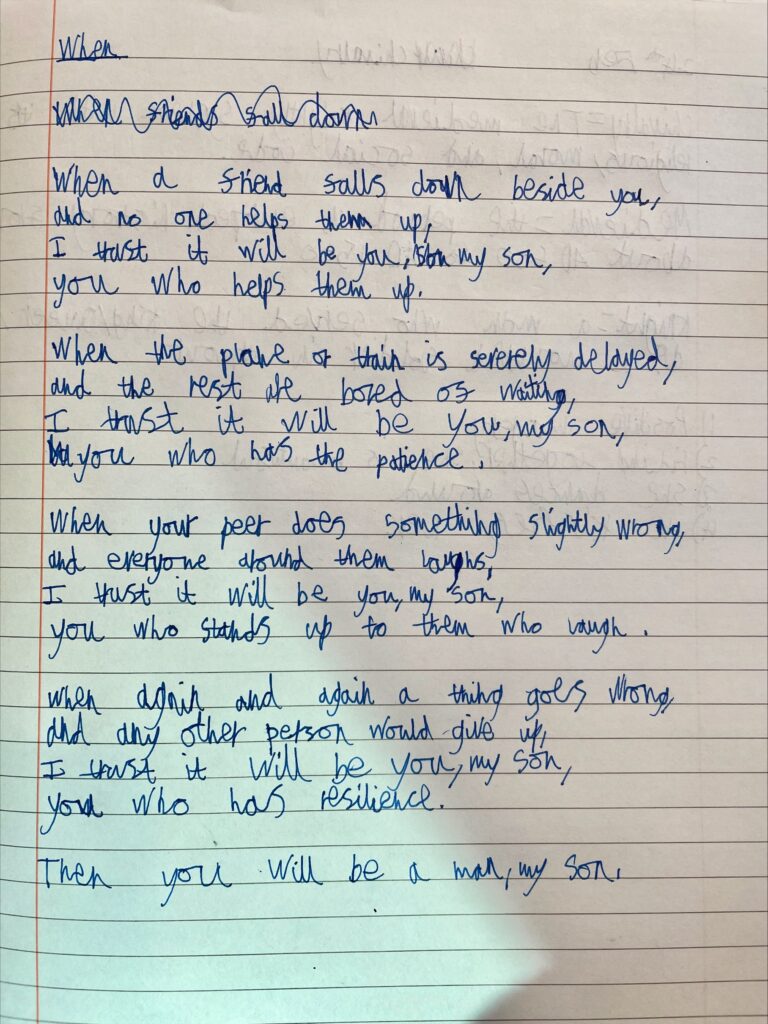
Students wrote poems to explore the theme of masculinity.
Toxic masculinity
After exploring stereotypes about men, I wanted students to explore toxic masculinity in detail. In order to make this non-judgemental in approach, we began our explorations from a historical viewpoint, exploring typical Victorian depictions of masculinity and then alternative depictions of manhood such as dandyism and black dandyism. In the next lesson, we analysed opposing male viewpoints of war by reading both Rupert Brooke’s ‘The Soldier’ and a letter that Wilfred Owen wrote to his mother. Students discussed how both soldiers felt about war, and then wrote a reply from Owen’s mother to Wilfred Owen.
Superheroes
It was important that the boys considered physical representations of masculinity, and we did when we explored the idea of a superhero. Students considered how superheroes have changed over the years, and whether depictions were more masculine or feminine in the 1970s. They then debated whether modern superheroes promote an unrealistic body image to young men. This was the ideal springboard to consider ideas about ‘Looksmaxxing’ and what it meant and whether boys had been impacted by it. The next lessons then explored the TV show Adolescence, the Manosphere, and articles about the TV show. Students debated whether Adolescence should be shown in schools. They did not watch the TV show in class but most of them were aware of it.
Role models
I felt that it was important that the unit ended by looking at positive male role models. I chose Marcus Rashford, Grayson Perry and Luke Littler as they were wide-ranging, contemporary and diverse examples of masculinity. The final activity in the unit gave students the opportunity to interview a male role model in the students’ lives. I wanted the boys to look to their families, friends or even staff members at school for these interviews, rather than the online influencers who had often helped to promote misogyny online to impressionable young men.
Final thoughts
The entire department taught the unit to Year Eight this spring and its reception has been overwhelmingly positive. Staffing in my department ranges from PGCE students and ECTs to teachers who are close to retirement. All teachers enjoyed teaching the unit, despite some of the challenging subject matter. The only criticism was that they needed more time, rather than the original three weeks, to do the unit justice and to allow the inevitable student discussion that happened in lessons. As there was no end of unit assessment, several teachers got the students to do presentations about masculinity to the rest of the class at the end of term. The students enjoyed being able to express their ideas about an issue that is close to their hearts, producing some thoughtful and creative work that was not bound by the confines of assessments and exam criteria. I think the examples of student work speak for themselves. It is quite clear that students learnt a lot from this unit.
Featured image by Craig McLachlan on Unsplash