‘The Unbounded Journey: the Teaching of First Language, Literacy, and Literature in a Dynamic World’
At the end of June the joint ARLE/IFTE Conference was held in a balmy Barcelona (although at a mere 31º C, incongruously cooler than the UK at the time, which was in the midst of a heatwave). This was, no question, a huge conference: 600 delegates, from 59 countries, presented 220 papers, posters, workshops, roundtables and keynotes across two university sites (Universitat Autonoma de Barcelona and the Universitat de Barcelona), in four languages and over four days.
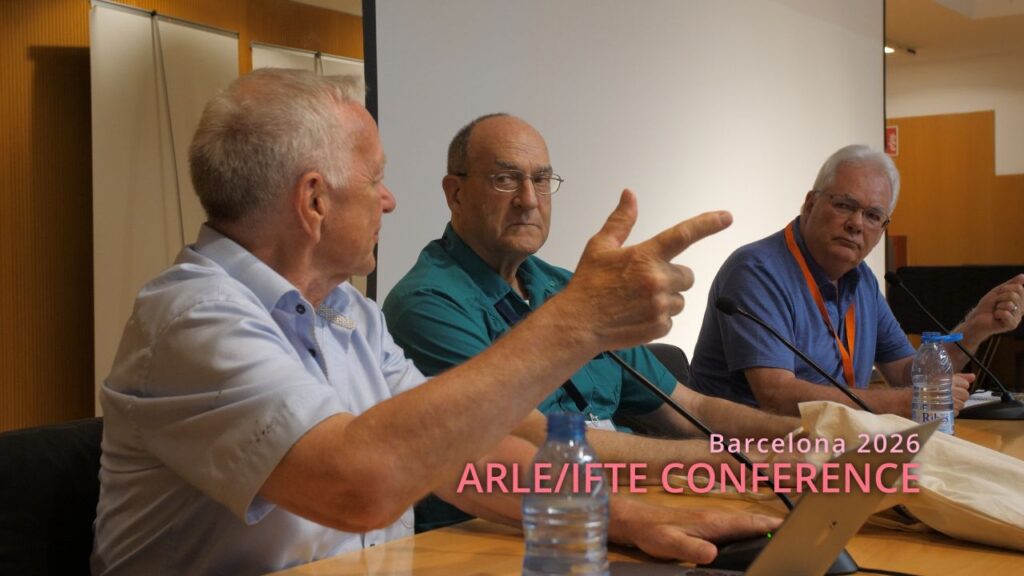
Bernard Schneuwly, Peter Smagorinsky and Andy Goodwyn
Jointly organised by ARLE (the International Association for Research in L1 Education) and IFTE (the International Federation for the Teaching of English), the conference was a vibrant coming-together of researchers and teachers passionate about the teaching of language and literature. As a teacher of English, in a predominantly English-speaking country, it is easy to forget that teachers of other languages and literature face many of the same challenges as we do. In part, for me, the conference served as a reminder that as teachers of First Language (sometimes denoted as L1), we are part of an international professional family and that there is much we can learn from each other.

Delegates in session at Universitat Autonoma de Barcelona
The over-arching theme of the conference was a celebration of the work of Lev Vygotsky (perhaps the most-cited but least-read academic in education). Vygotsky’s sociocultural theories of learning, particularly the social aspects of learning and the importance of language, speaks to the heart of L1 language and literature learning; a pedagogical principle that puts texts and language and students’ responses/interactions at the centre of everything that it does.
Peter Smagorinsky’s opening keynote was a reminder of the dangers of relying on second-hand summaries, often generated from poor translations (Vygotsky’s work, written in Russian, was not translated into English until the 1960s, thirty years after his death). An example of this is in the notion of the ‘Zone of Proximal Development’, probably Vygotsky’s most famous concept, which Professor Smagorinsky argued was mangled in translation, a better phrasing of which would be the ‘Zone of Next Development’.
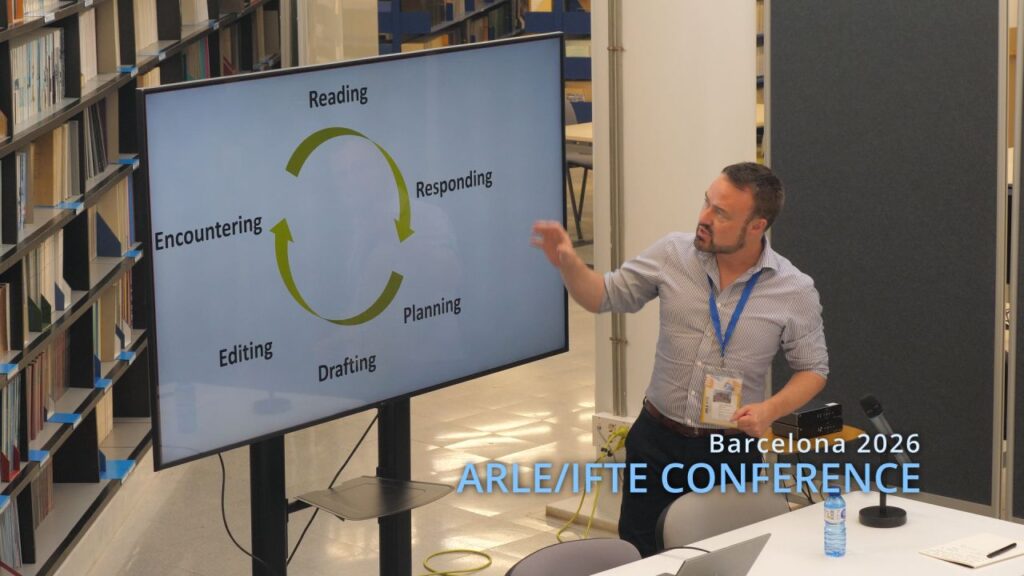
Anthony Cockerill, Director of NATE, presenting as part of a symposium with Steve Connolly, Symon Quy and Joanne Bowser-Angermann
Words matter! John Perry’s presentation, on Matthew Arnold, highlighted the end of the sentence of Arnold’s in the often quoted ‘the best that has been thought and said… in the world’. Inclusion of those three additional words would make quite a difference to the opening statement in the National Curriculum! Dr Perry’s paper was part of a series linked to Routledge’s ‘Key Thinkers in English in Education in the Language Arts’, which has already published volumes on Vygotsky (Smagorinsky, 2023), Harold Rosen (Gibbons, 2024), John Dixon (Sawyer, 2026).
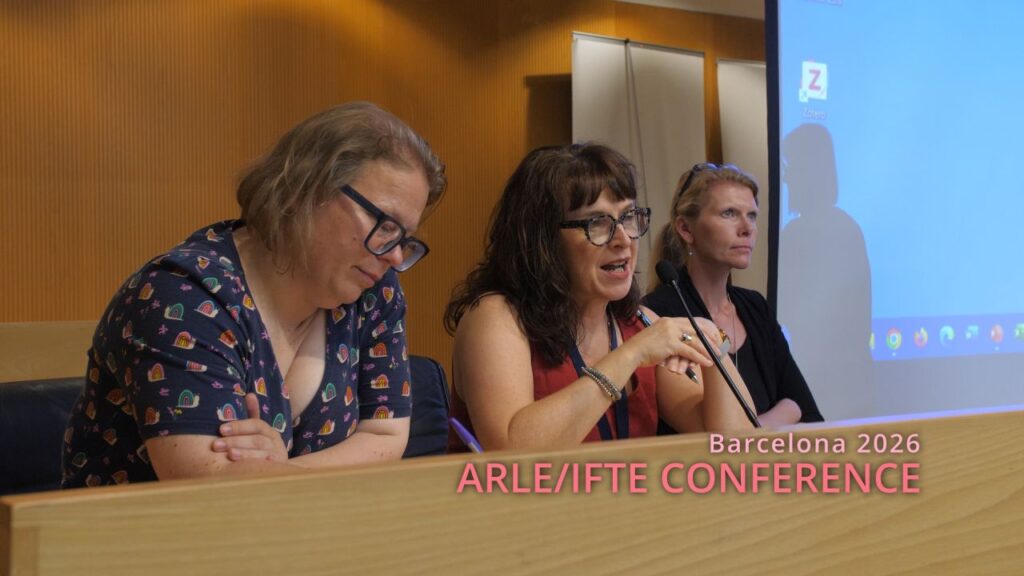
Velda Elliot, Larissa McLean Davies and Ruth Newman
Other papers included forthcoming subjects of the series: James Britton (Goodwyn), Peter Medway (Marshall), John Dewey (Hopkins & Belas), and Louise Rosenblatt (Roberts). Do these thinkers from a by-gone era have any relevance for the twenty-first century L1 classroom? In a challenging educational climate, beset by continued accountability measures, curriculum reform and the pervasiveness of AI, I was struck by how often contemporary debates return to questions posed by Vygotsky, Dewey, Rosenblatt, Britton and Rosen. L1 teaching and research may have new technologies and challenges, but many of its fundamental questions remain the same: what counts as knowledge? How do learners make meaning? What is the relationship between personal experience and disciplinary understanding?

Lesley Nelson-Addy and Lorna Smith
The range of papers and presentations covered topics on dialogic teaching, grammar, diversity in literary texts (Lesley Nelson-Addy and Velda Elliott celebrated the amazing work from the Lit in Colour project), and the relationship between L1 learning and AI. What emerged for me as a running theme, was the importance of dialogue: conversation, response, discussion as the dominant mode of L1 pedagogy. Our students need to be active readers, writers, speakers, listeners and must engage with, respond to, create their own texts and this is central to all L1 teaching and learning, regardless of national contexts and challenges.
How we navigate the sirens of AI and Cyclops of accountability measures and curriculum reforms is our collective endeavour for the future. The ARLE/IFTE conference was a reminder for me that this is a journey I don’t have to undertake alone.
Featured image: iStock:Lobro78. All other images courtesy of ARLE/IFTE.