James Durran reflects on his friendship with the late Jim Stewart
My close friend Jim Stewart, who has died, aged 67, after a rapid progression of Parkinson’s, was a devoted English teacher and a loyal friend of NATE. Together, he and I were joint Conference Officers for the 1997 NATE National Conference in York.
Jim began his English teaching career at Samuel Ward School in Haverhill, Suffolk, before moving to become Second in English at Ernulf Community School, St Neots. It was there that I first worked with him, when I joined the English Department as a raw probationer in 1989. Under the inspirational leadership of Gabrielle Cliff Hodges (NATE Chair, 1996-98), it was an exciting department to teach in. Straight away, Jim became a firm friend, and I learned much from him. His neighbouring classroom was a happy, buzzing place, in which students’ personal, imaginative and creative responses to texts were always foremost. And the department was a site of progressive innovation, as well as of activism — we organised county-wide protest at the Major government’s diminution of coursework. And we were energetically involved in the local branch of NATE.
In the 1990s, such regional branches were the foundation of the organisation, and Cambridgeshire’s thrived, led by and giving nurture to influential figures in the English teaching world — Gabrielle Cliff Hodges, Andrew Burn, Paul Bunyan, Simon Wrigley, Gary Snapper… Saturday morning NATE Conferences attracted delegates from all over the region — a dynamic, local network of English teachers.
In 1991, Jim moved to be Head of English at St Peter’s School, Huntingdon, where, in various roles, he stayed until his retirement in 2015. I joined him as Second in English in 1993 and it was a privilege to work closely with him to design curriculum and to shape practice. Together, we moved English from tight setting to full mixed-ability. For Jim, who spent his career teaching in challenging schools, this was crucial to a greater project. He always saw English teaching as a deeply humane and moral pursuit. It was never just about objectives and exams, but was about developing an enriching, empowering conversation, in which all students were participants. His friend and colleague Stewart Simpson — a chemistry teacher — describes watching Jim taking a class through an analysis of Sylvia Plath’s poem Metaphors as ‘the best lesson I ever saw’. And I can imagine what he did see: not just the decoding of meanings and the identification of parts, but the patient drawing out of possibilities, the making of genuine connections to personal experiences, and the gradual assembling of authentic understandings. And he would have witnessed students enjoying themselves — enjoying building agency as readers and as talkers — having fun. Writing to me, one ex-student has described Jim’s teaching as ‘full of knowledge, enthusiasm, humour and encouragement. He made words come alive in the classroom; they were no longer inaccessible monochromatic symbols on the page but colourful and relatable.’
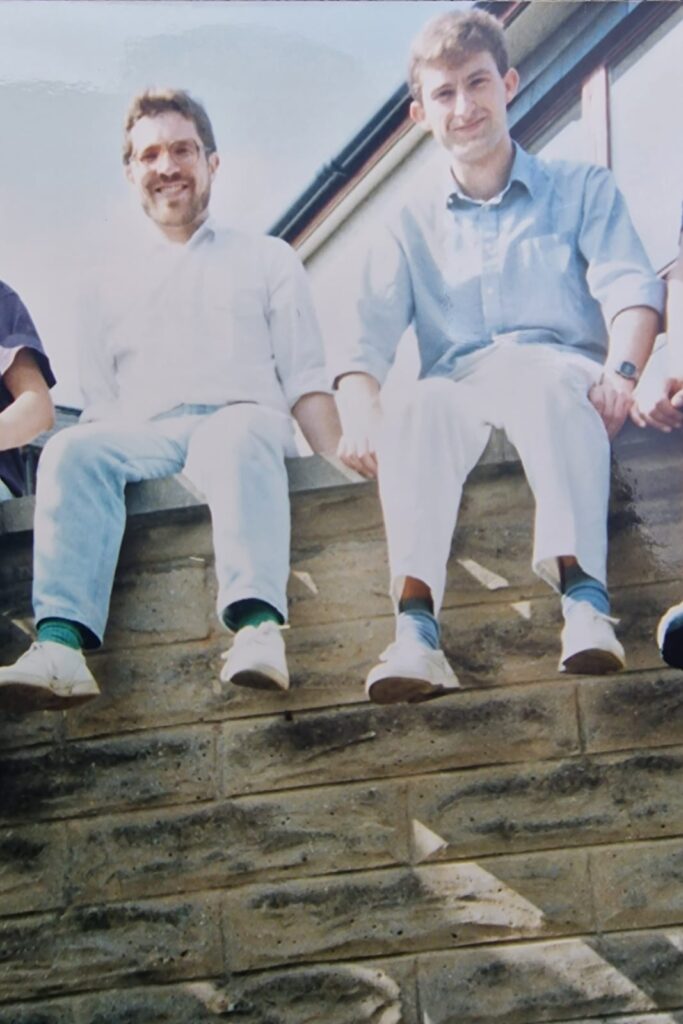
Jim Stewart and James Durran
Jim had a passion for Shakespeare, which he knew better than anyone I have met and could quote from with ease. He had seen every play (most of them many times), he specialised in teaching Shakespeare at A-level, and in retirement he spent several happy years stewarding at The Globe. This love of theatre was a core part of his identity as a teacher. He worked as hard as possible to lift dramatic texts off the page, both in the classroom (Rex Gibson-style) and in an astonishing number of theatre trips. In one term alone, we took eight trips — to London, to Leicester, to Stratford. (In the 90s, trips were much easier to organise; I don’t remember any risk assessments or contact lists — just permission slips, a coach and a rough estimate of when we’d return.) Some of my happiest memories of this time are of those trips, which were about much more than just seeing plays. (I remember queuing with Sixth Formers, first thing in the morning, for National Theatre ‘returns’, then spending the day exploring London and the river, before an evening performance and the late-night drive back to Huntingdon.) Jim was one of the people from whom I learnt that being a teacher is something lived and breathed; it is about relationships, values and experiences way beyond the transmission of knowledge in the classroom.


In 1995, I left to run my own department, but Jim and I continued to work together. In 1997, we were joint Conference Officers for the NATE National Conference. These were large-scale, three-day events, for each of which the two-years of planning was delegated to a regional branch: in this case, Cambridgeshire. Our job was to coordinate a very hard-working, talented committee, and I learned much from Jim’s organisational ability. This was pre-email, and we spent hours putting agendas and minutes in envelopes and awaiting postal replies from invited contributors. The theme was ‘Message from the Classroom’, with a focus on the social aspects of learning, on the way relationships and classroom culture are intrinsic to English teaching, and on what can be learned from students themselves. The two years of organisation and the days in York were a time of intense social, emotional and intellectual investment for all those involved, and Jim’s energy and intelligence was vital to its success.
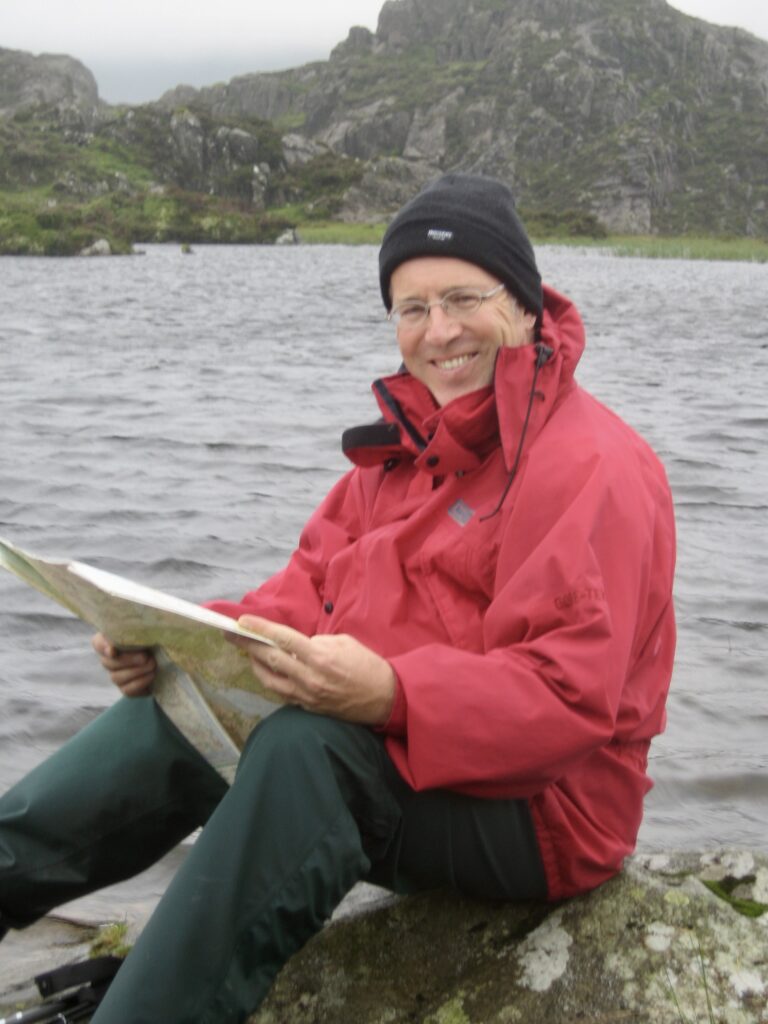
Jim continued to be involved with NATE, serving on the board as an ex-Conference Officer, and attending conferences. And I continued to work with Jim; together, we wrote several books and resources, for students and for teachers. And Jim remained a constant friend, from whom I learned so much about music, comedy, theatre, walking in the hills, laughter, and the supreme value of silliness. He retired from the classroom in 2015, but he never stopped being a teacher at heart. He will be deeply missed, by the many friends who loved him, by his family in Yorkshire, by those he worked with, and by the students for whom he made those words come alive.