

In light of forthcoming curriculum changes that could place greater emphasis on English Language, Caroline Godfrey explores ten influential titles for teachers keen to deepen their understanding of linguistics, recommended by NATE’s Language Working Group
The Curriculum and Assessment Review’s final report, published at the end of 2025, lists one of their main priorities for secondary school English as being revising the GCSE English Language course to develop a firmer focus on ‘the nature and expression of language (including spoken language)’. One of the prime reasons for this, as stated in the report, is to ensure that in the future, the Language and the Literature GCSEs have distinct identities. The current situation, in which the GCSE English Language exam is simply another version of literary study, packaged differently, reflects the formula upon which most secondary school English departments run, a formula which equates English primarily with English Literature or the study of books.
Since the last curriculum reform in 2014, the language element of English has been squeezed out to such an extent that, for many English teachers, the idea of incorporating any kind of linguistics into their secondary curricula seems distinctly foreign. As a working group, our concern is that given the current focus on English as literary study, many English teachers, understandably, will not know where to start in preparing for a potentially seismic change in English curricula policy. We hope that the following list therefore provides a variety of reading suggestions for any English teachers interested in improving their knowledge on language and linguistics and who would like to consider how elements of these disciplines might be incorporated into a wide-ranging and forward-thinking contemporary curriculum for the second quarter of the twenty-first century.
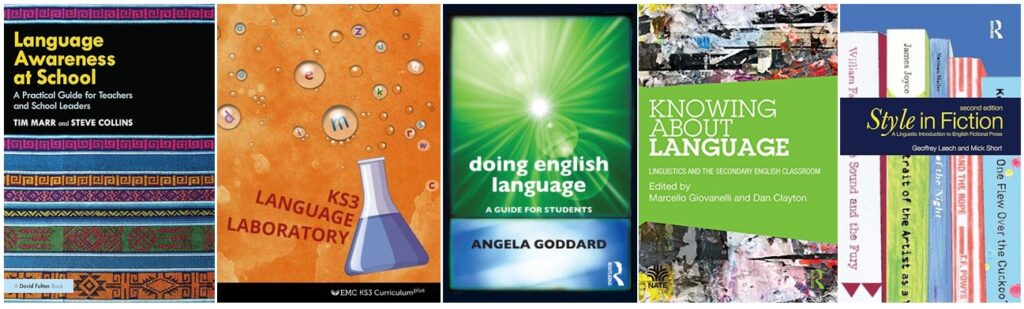
- Language Awareness at School: A Practical Guide for Teachers and School Leaders (2023) by Tim Marr and Steve Collins
In this book, Marr and Collins present their argument that ‘the classroom and the school should function as a natural site for noticing and talking about language, and for exploring language behaviour in all its facets’. Building on our natural human curiosity about language, embedded in this idea of ‘noticing’, the authors make a case for integrating critical language awareness into English and MFL departments, cross-curricular work and school policy. - KS3 Language Laboratory (EMC KS3 Curriculum Plus) (2018) by Dan Clayton and Andrew McCallum
An eminently practical guide offering a range of resources and suggestions encouraging teachers to approach language as ‘a rich resource, there to help pupils make sense of the world’. Multiple different ways to engage with language at Key Stage 3 are featured in this book, ranging from resources focused on the language of literature and the use of ‘voice’ in narrative to questions about accentism and debates about school language policies. - Doing English Language: A Guide for Students (2012) by Angela Goddard
Designed as a companion volume to Robert Eaglestone’s Doing English: A Guide to Literature Students, this book is aimed primarily at students considering taking language-related courses at university. However, in its coverage of the history of the study of English language and linguistics and its focus on the range of different areas included within these fields, as well as information on research methods, there is a lot in this guide that teachers will find helpful. - Knowing About Language: Linguistics and the Secondary English Classroom (2016) edited by Marcello Giovanelli and Dan Clayton
Arguing that for well over a hundred years, language work in schools has been overshadowed by debates about the place and value of formal grammar teaching and the relative value of different varieties of English, Giovanelli and Clayton have collected together a range of essays that explore ‘more revealing questions about attitudes, competences, psychologies, social interactions, individuals and communities’. Together, these essays present ways into a descriptive study of language as a system through the very people that use it every day. - Style in Fiction: A Linguistic Introduction to English Fictional Prose (2nd edition) (2015) by Geoffrey Leech and Michael Short
A classic in its field, Leech and Short demonstrate how stylistic analysis, with its focus on the language of literature, can be applied to novels and stories. Working mainly with texts published in the past 150 years, Leech and Short highlight how linguistic analysis and literary appreciation can be combined rather than held at arm’s length. Their analysis leads the reader to a deeper understanding of how literary style is comprised and how writers achieve their effects through language. - Cambridge Topics in English Language, series edited by Dan Clayton and Marcello Giovanelli
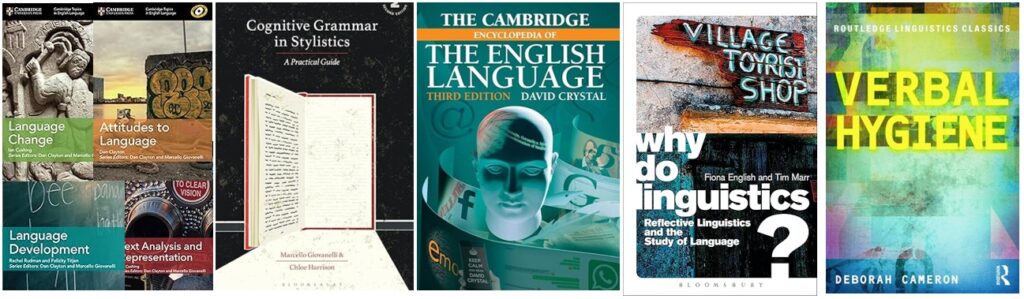
This series, covering topics as broad ranging as ‘Language and Power’, ‘Language Diversity’ and ‘Language Change’, aims to provide accessible but scholarly introductory guides to significant topics in the fields of English language and linguistics. Aimed primarily at students, teachers will also find much of use in these books, which include a range of practical and contemporary examples of language in use, as well as helpful further reading lists at the end of each chapter. - Verbal Hygiene (2012) by Deborah Cameron
Now seen as a linguistics classic, Cameron takes a critical look at popular attitudes to language and the way that everyday users consistently seek to regulate its use. Verbal hygiene, which Cameron defines in her ‘Preface’ as ‘the urge to meddle in matters of language’, can be seen in the regulation of style by editors, the teaching of grammar in schools and the movements for and against ‘politically correct’ language. A book which ultimately highlights the importance of developing an informed and critical understanding of language as it is used in the everyday world. - Why do Linguistics? Reflective Linguistics and the Study of Language (2015) by Fiona English and Tim Marr
English and Marr’s book is firmly focused on the messy, everyday world of language use, or social linguistics. The authors’ primary aim is to highlight the benefits of turning a linguistic lens onto ‘the communication that surrounds us every day and everywhere’. This means that above all, it is a book about noticing, and in three parts the authors pose a series of questions about language practice and beliefs and outline the basic tools of linguistic description, before finally arguing for the wider application of linguistics due to its relevance to all our real-world experiences. - The Nottingham Stylistics Toolkit
Designed by a team of academics at Nottingham University, explicitly for teachers, this toolkit aims to highlight the utility of stylistics at the secondary English level. As above, stylistics can be defined as the practice of applying insights from linguistics to the study of literary texts. Each entry included in the stylistics toolkit includes a thorough definition, a worked analysis, a classroom handout and suggestions for further reading. Entries range from concepts that might be quite familiar to teachers, such as atmosphere, character and tone, to topics that might represent new knowledge, such as phonoaesthetics and Text World Theory. - The Cambridge Encylopedia of the English Language (3rd edition) (2018) by David Crystal
A supremely useful and comprehensive guide to the history, structure and usage of the English language. A book which Crystal refers to as ‘a daring enterprise’ tells the many different stories of English in a series of full-colour double-page spreads. Primarily designed for readers to ‘dip into’, each double-page comprises a self-contained overview of a particular aspect of language study. In this third edition of the encylopedia, Crystal includes new sections on English in a post-Brexit Europe, changing oratorical styles of American presidents and social media and online language play, as well as providing more expected updates on the growing cultural identities of ‘new Englishes’. A really worthy investment for anyone interested in the English language.
And one final bonus book for good luck!
- Cognitive Grammar in Stylistics: A Practical Guide (2nd edition) (2024) by Marcello Giovanelli and Chloe Harrison
Cognitive grammar is a model of grammar that refers to how ‘our use and understanding of language is shaped by our physical experience in and with the world’. The authors argue that one of the most helpful aspects of talking about units of language in this way ‘is that it allows us to move from the idea of grammar as following certain rules‘. Instead, we are invited to consider ‘the relationship between lexicon and grammar in particular usage events‘. Each chapter of this guide explores an important aspect of cognitive grammar in a straightforward and accessible way, and although the book is primarily aimed at undergraduates, many of the example extracts exemplifying grammatical concepts are taken from texts that teachers routinely use in the classroom.
